
The countdown to the comrades marathon has begun
MEET THE ROC: THE ROUTE GURUS
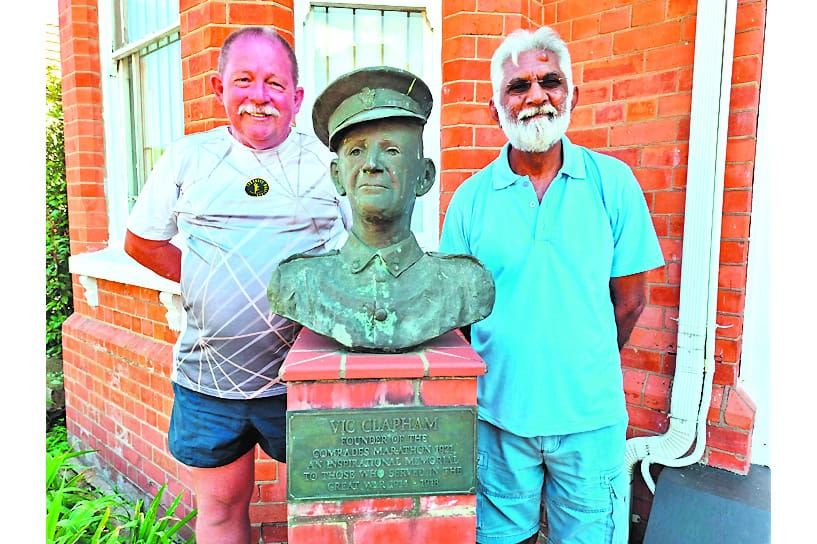
After more than a decade of looking after the Route Portfolio for the Comrades Marathon’s Race Organising Committee (ROC), convenors Ravin Sivraman and Braam Zaayman have been around the proverbial block enough times to know all the ins and outs of the job. We chatted to them about route markings, cut-offs and high-fives on race day. – INTERVIEW BY SEAN FALCONER
The famous saying is that when you’ve travelled a specific route many, many times, you eventually know it as well as the back of your hand… Well, when it comes to the Comrades Marathon, long-serving Route Portfolio convenors Ravin Sivraman and Braam Zaayman know every turn, every intersection, every hill, and perhaps even every speed bump, because this has been their “office” for well over a decade. They’ve lost count how many times they’ve travelled the historic route between their Pietermaritzburg ‘hometown’ and Durban.
Ravin (68) is semi-retired and his journey with the Comrades Marathon started in 2002, when he began volunteering to work at the start and finish. In 2012 he was offered the post of Route Portfolio Convenor on the ROC. Braam (60), is a retired Correctional Services officer who earned six finisher’s medals between 1999 and 2011, then joined the ROC and began helping to organise the event instead, eventually becoming the assistant convenor of the Route Portfolio.
During a recent route recce we caught up with the two for a chat about the important role they play in the race.
Q. Let’s start with you explaining what you do as convenors of the Route Portfolio on the ROC?
Ravin: It starts very early in the year where we do drive-throughs to check the condition of the roads and make notes about damage or potholes, so that we can send our reports to the different municipal or provincial authorities to have repairs done.
Braam: That starts as early as January already, and we keep on doing follow-ups on that, as well as liaising with the contractors while roadworks are going on. Later we do the route measurement, followed by the route marking, including putting up all the yellow route signs, and generally, we just do everything that needs to be done on the route.
Ravin: Braam and I also go out to do recce work with the speed fencing and toilet facility guys, to decide where we need to fence off the route, and where we will place toilets. We also need to decide where to allocate parking for bailer buses on race day. There are a lot of things like that, which need to be done before the race.
Q. Let’s talk a bit more about the route measurement and marking. What goes into that process?
Ravin: Well, we go out with the course measurer, Mike Rooke, who does the actual measurement on a bicycle, so together with the traffic and Metro services, we protect him on the busy roads by driving behind him, and he tells us where to put the kilometre marks. With all the recent roadworks, we have to remeasure every year, because the route changes all the time, and that affects the actual points where the kilometre boards must go.
Braam: The route marking with the yellow boards then takes place about two weeks before the race, and that’s a two-day job. We start on the Friday evening with a group of volunteers preparing the boards by feeding wire through the eyelets and packing the vehicles, and then 6am on the Saturday we start, with six teams leapfrogging each other as we mark the whole route from start to finish. Fortunately, most of those boards get taken by runners, so we only need to take down the odd ones here and there after the race.
Q. I believe you have a special tradition when it comes to these marker boards?
Braam: Yes, we always hang one board upside down, just after halfway at the Wall of Honour, in memory of fallen volunteers or friends. It’s our way of paying tribute to those who are no longer with us.
Q. What about on race-day itself?
Braam: On the day before the race, we ensure that the clocks are working properly and fitted onto the lead vehicles for the men’s and women’s races, as well as the cut-off vehicles. So, if you’re lucky, you might get some sleep, otherwise you put in a 45-hour shift.
Ravin: Race day is a very early start for us, just after midnight. We drive the route and check that everything is fine, and we check for any ambush marketing as we go. We are never at the start, as we are already further up the route, and then later in the day we are at all the cut-off points.
Q. Does that mean you literally move from one cut-off point to the next, and actually handle the cut-offs?
Ravin: Yes, we have to race through as fast as we can safely get through all the runners, to get to the next point to do the cut-off, even though it’s a horrible part of the job
Braam: Ja, that is more than horrible. It’s heartbreaking to see runners collapsing in front of you because you cut them off. That’s not nice to do, and not nice to see, but someone has to do it.
Q. With this race route dating back to the 1920s, is that incredible history always front of mind in your work on the Route Portfolio?
Ravin: Very much so. Even though the route has changed a lot over the last century, we have to make sure that the history is kept alive, including running through certain sections and past certain landmarks. You cannot bypass those, and that is one of the biggest challenges of the job, because the roadworks on the N3 and on the R103 mean we constantly have to adapt our plans. But that also keeps it interesting. Fortunately, the contractors involved are very cooperative, and they really come to the party when it comes to Comrades Marathon.
Q. Approximately how many volunteers work on the Route Portfolio?
Ravin: We have about 70 to 80 volunteers working on our portfolio, and that includes those doing the build-up, the route marking and then race day itself. We also have the lead vehicle drivers, the cut-off staff, the sweeper volunteers, and more in our portfolio.
Braam: Ravin and I really want to thank all the volunteers in our portfolio, as well as all the spouses and families, ours included, for allowing us all to do what we so love doing. I’d also like to thank finish venue convenor Tonya Swiegers and Refreshment Station convenor Chris Bent, who we work very closely with.
Q. After so many years of being involved in the event, I would imagine you’ve got many fond memories and highlights to look back on?
Ravin: To me, the whole race day is a highlight, but I think for Braam and I, one of the highlights is when we place the bouquet of flowers at Arthur’s Seat on the Friday morning before the race. Then on race day, another huge highlight is seeing the kids at the Ethembeni Special School alongside the road, holding their hands out for high-fives from the runners.
Braam: Ja, those kids are a real tear-dropping highlight, but there are so many highlights every year, and just being on the route with all the people, and with runners who are friendly and chirp you, makes it all worthwhile. Also, a personal highlight was the one year when we made all the kilometre marker boards at my house, because it was nice to see all that hard work out there on race day.
Q: Do you have any idea how many times you drive the Comrades Marathon route each year?
Ravin: I couldn’t say, because we honestly don’t count, but I do know it’s a lot of times. We also don’t know exactly how many speed bumps there are on the route, but we can tell you that that there are quite a few.
Braam: I think it is at least 100 times maybe. Whatever it is, it’s a hell of a lot, and we get to a point where we can almost tell you exactly where each kilometre board is going to be.
Q. There is also a lot of hard work, which requires a lot of time and sacrifice. So, what brings you back year after year?
Ravin: It’s the friendship. You develop a family bond with your fellow ROC members, and they become part of your family, people that you stay in contact with right through the year, because they’re such wonderful, amazing human beings. You actually miss them when things are quieter. Braam: That’s 100% true. It’s like a family reunion every year when we come together and start with the planning for the next race. In this ROC, you build friendships for life, ones that you’ll never lose.